Autonomous Collision Avoidance
Proactive threat detection using advanced multi-spectrum sensor fusion.
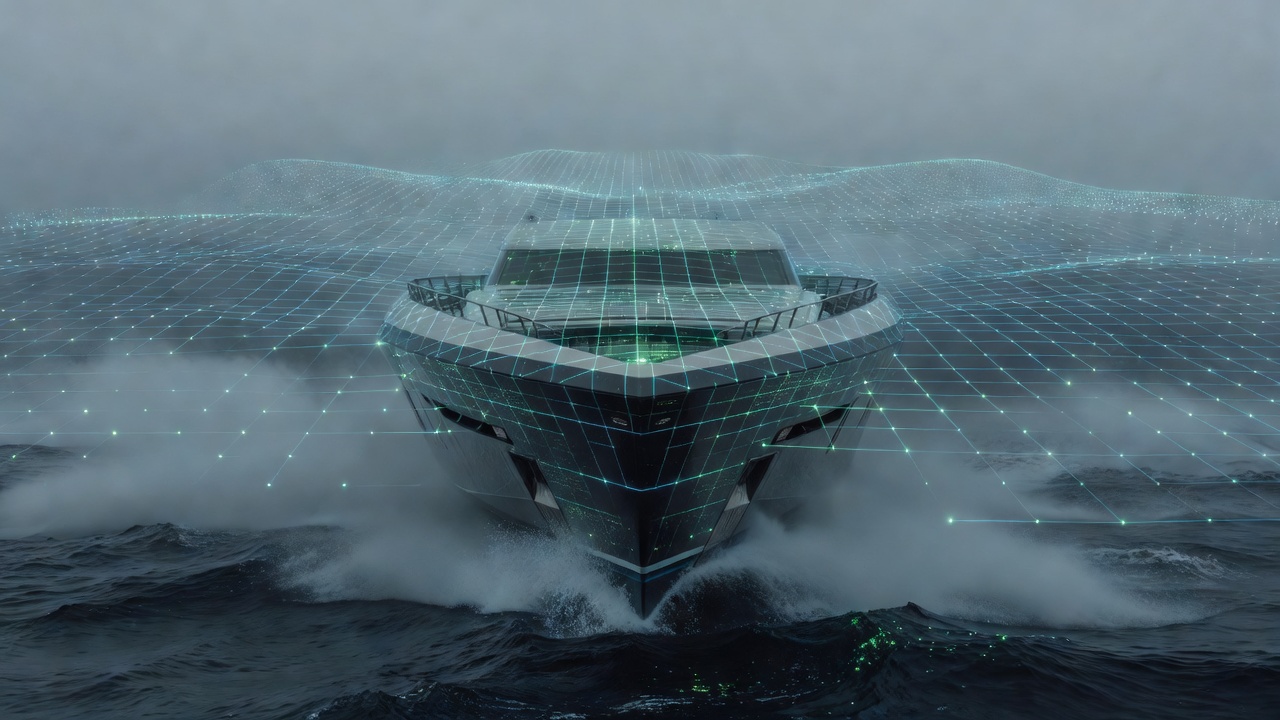
Nighttime navigation, heavy fog, and crowded shipping lanes present some of the most stressful environments for yacht crew. Historically, mariners have relied on a combination of visual lookouts, Automatic Identification System (AIS) broadcasts, and marine radar. While these tools are essential, they each suffer from isolated limitations. Visual watches suffer from fatigue; AIS requires the target vessel to actively transmit data; and radar can be obscured by heavy rain clutter or sea state.
Autonomous collision avoidance systems resolve these blind spots through a concept known as "Sensor Fusion." By layering multiple data streams into a single central processing unit, the AI can synthesize a comprehensive, 360-degree digital twin of the yacht's surroundings in real time.
The Components of Sensor Fusion
A robust AI collision avoidance network does not rely on a single input. It requires a symphony of hardware working in tandem:
- Solid-State Doppler Radar: Instantly detects the velocity and direction of moving targets, painting them in different colors depending on whether they are approaching or retreating.
- AIS (Automatic Identification System): Provides verified vessel data, including MMSI, heading, rate of turn, and destination.
- Thermal / Infrared Cameras: Crucial for detecting targets that do not appear on radar and don't broadcast AIS, such as floating shipping containers, icebergs, or small wooden fishing vessels at night.
- Marine LiDAR: Fires rapid laser pulses to map the immediate vicinity in three dimensions, particularly useful during close-quarters maneuvering and docking.
Evaluating Avoidance Systems
When selecting a collision avoidance suite, not all systems operate with the same level of autonomy. It is important to understand the different classifications of digital safety systems.
| System Level | Functionality | Crew Requirement |
|---|---|---|
| Level 1: Advisory | Highlights hazards on displays and sounds alarms based on Closest Point of Approach (CPA). | Crew must acknowledge alarms and execute the physical helm maneuvers. |
| Level 2: Corrective | Proposes specific helm and throttle adjustments to avoid detected hazards. | Crew must approve the suggested maneuver before the system executes it. |
| Level 3: Autonomous | Detects, decides, and executes evasive maneuvers independently, notifying the crew simultaneously. | Crew monitors the system and can override at any time. |
COLREGs and Algorithmic Compliance
One of the most complex challenges in developing marine AI is teaching a computer to adhere to the International Regulations for Preventing Collisions at Sea (COLREGs). These are not simple mathematical rules; they require interpretation. For instance, determining if a vessel is an "overtaking" vessel versus a "crossing" vessel dictates who has the right of way.
Modern AI systems are programmed with highly complex decision trees modeled directly on COLREGs. If a target is detected off the starboard bow on a steady bearing with decreasing range (a classic collision course), the AI calculates the necessary starboard turn to pass astern of the target vessel, ensuring the maneuver is made early and is large enough to be readily apparent to the other vessel, as required by maritime law.
Challenges: False Positives and Clutter
Despite the incredible advancements in neural networks, false positives remain a hurdle. In steep, breaking seas, wave crests can occasionally be interpreted by radar and LiDAR as solid objects. A poorly tuned AI might initiate a hard evasive maneuver to avoid a rogue wave that poses no structural threat.
To mitigate this, high-end systems use historical sea-state data and machine learning to filter out "clutter." The software learns to distinguish between the chaotic, fleeting signature of a wave and the persistent, solid return of a submerged shipping container or small craft. Continuous software updates, fed by data collected from fleets worldwide, ensure these AI models are constantly refining their object recognition capabilities.