AI Route Optimization
Moving beyond static waypoints to dynamic, machine-learning-driven voyage planning.
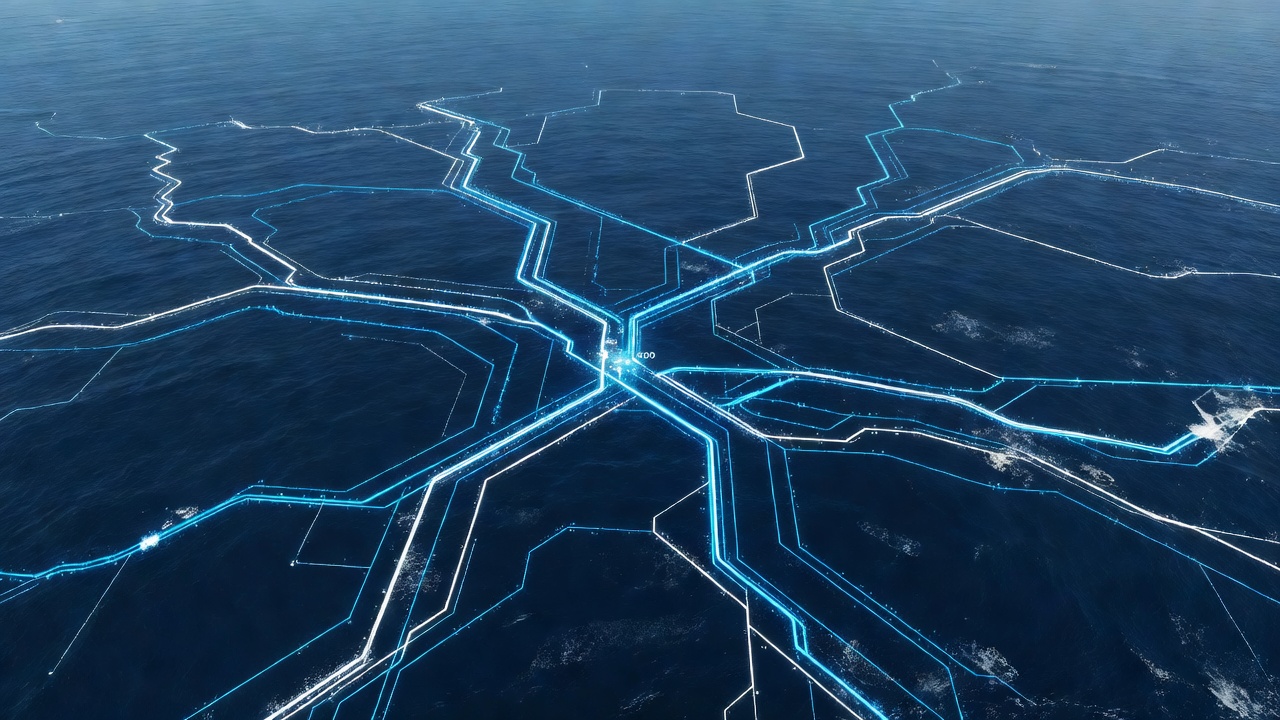
For decades, passage planning has relied on a relatively linear methodology: a navigator charts waypoints, consults pilot charts for historical currents, and downloads a GRIB file for wind forecasts. While this traditional approach has safely guided vessels across oceans, it is inherently static. Once a yacht departs, conditions deviate from the forecast, and the pre-planned route rapidly becomes suboptimal.
AI route optimization represents a paradigm shift in marine navigation. By leveraging continuous data streams and advanced heuristic algorithms, modern navigation systems can calculate thousands of potential routes in milliseconds, isolating the single most efficient path based on real-time environmental data and specific vessel performance metrics.
The Mechanics of Algorithmic Pathfinding
Traditional marine chartplotters calculate distance using simple Great Circle or Rhumb line geometry. Artificial intelligence, however, treats passage planning as a complex, multi-variable calculus problem. The system integrates multiple crucial datasets:
- Hydrodynamic Polars: The AI ingests the specific vessel's polar performance data—understanding exactly how the yacht accelerates, drifts, and consumes fuel at various angles to the wind and varying sea states.
- Oceanographic Currents: Incorporating real-time satellite altimetry and buoy data to ride favorable eddies and avoid contrary currents.
- High-Resolution Weather Models: Utilizing continuous updates from global models (like ECMWF and GFS) blended with localized, high-resolution models to anticipate wind shifts and frontal passages.
- Draft and Bathymetry constraints: Ensuring all proposed routes maintain safety margins regarding underwater topography and tidal variations.
Traditional Routing vs. AI Optimization
| Feature | Traditional Navigation | AI Route Optimization |
|---|---|---|
| Route Adjustment | Manual intervention by the crew when conditions change. | Continuous, autonomous recalculation based on live sensor data. |
| Fuel Efficiency | Reliant on crew throttling and static RPM tables. | Dynamically adjusts requested RPM and course to optimize fuel burn curves. |
| Sea State Handling | Reactive steering based on visual wave observation. | Predictive routing to actively avoid severe wave heights and slamming zones. |
Pros and Cons of AI Routing
The advantages of integrating machine learning into voyage planning are substantial, but they are not without trade-offs. Understanding these constraints is vital for any master or owner considering an electronics refit.
The Advantages
The most immediate benefit is efficiency. By constantly analyzing the vessel's progress against the forecast, the AI can suggest micro-adjustments—altering a heading by just two degrees to catch a favorable current over a 200-nautical-mile stretch. Over a long passage, these micro-adjustments compound, saving significant fuel and reducing engine running hours. Furthermore, safety is vastly improved. The system can be programmed with hard constraints, such as "never route through waves exceeding 4 meters" or "maintain a minimum 20% fuel reserve," and the AI will mathematically guarantee those constraints are met or alert the crew before departure.
The Limitations
The primary drawback of AI routing is its heavy reliance on data integrity. The phrase "garbage in, garbage out" is highly applicable here. If the vessel's satellite internet connection drops, the AI cannot download the latest weather models, degrading the system to function much like a traditional chartplotter. Additionally, the algorithms depend heavily on accurate initial vessel profiling. If the yacht's polar data is entered incorrectly, or if the hull is heavily fouled and not performing to spec, the AI will make optimistic routing decisions that cannot be achieved in reality.
The Future of Passage Planning
As satellite constellations continue to provide broader bandwidth at sea, the capability of AI route optimization will only expand. We are moving toward a future where a yacht's navigation system communicates directly with engine management computers, seamlessly altering throttle positions and rudder angles to execute the mathematically perfect voyage from dock to dock.